The Treasury Department says the total U.S. government budget deficit for May was $130B. The announcement comes after a big $106.9B surplus in April caused by the inflow of tax revenues. Although the budget for the first eight months is still down from the same period in 2013, the current shortage still totals $436.4B. The Congressional Budget Office forecasts a full year deficit of $492B ending September 30.
Thursday, June 12, 2014

Tuesday, June 10, 2014
If you wish to buy a car, but cannot afford to pay the monthly installment, what's the way out? Extending the loan period seems like one solution. This is what seems to be happening in the US right now. As per Moneynews, a growing number of Americans are looking to extend their loan terms for buying vehicles to as many as 11 to 12 years! As reported by Wall Street Cheat Sheet, one-fourth of new vehicle loans ranged from 73 to 84 months, up 27.6 % from a year earlier. In any way you look at this, it seems like a cause of concern and one that could lead to being a bubble situation. Especially considering that such buyers would end up paying a lot more in the form of interest payment; and could possibly face issues when it comes to trading their vehicles for a new model! Not to mention, this route is mainly being taken by people who don't have the best of credit records.
The new government seems to be taking some baby steps towards some crucial reforms. There is some good news regarding the coal sector. The sector may be opened to private players with conditions attached. The government is considering a proposal to auction mining leases to private bidders. This would include the leases to those areas that Coal India is unable to mine. The Coal ministry is also developing a long term plan to reform Coal India by 2030. This would be in line with the new governments view to reform PSUs instead of privatizing them.
While these steps will certainly help, we believe that if the government were to go in for reforms in any sector, it should be decisive. Coal India is a cash rich PSU that enjoys a monopoly. The government should consider ending its monopoly. Participation of private companies with a proven track record into the coal mining sector should be allowed. This will lead to an increase in the supply of this important commodity in the local market. Indian power companies will then not need to import a commodity that it has in abundance.
While these steps will certainly help, we believe that if the government were to go in for reforms in any sector, it should be decisive. Coal India is a cash rich PSU that enjoys a monopoly. The government should consider ending its monopoly. Participation of private companies with a proven track record into the coal mining sector should be allowed. This will lead to an increase in the supply of this important commodity in the local market. Indian power companies will then not need to import a commodity that it has in abundance.
Monday, June 9, 2014
Asian stocks hit their highest levels
In nearly three years today, after the Dow Jones and S&P 500 ended at new records this past Friday. The Nikkei stock average is up by over 0.3%, and Hong Kong up 0.7%. The yuan rose after the People's Bank of China unexpectedly fixed its daily midpoint higher against the dollar for the second straight session, leading to an additional rise in other Asian currencies.
Sunday, June 8, 2014
RBI has hiked the LRS Limit to US$125000 from the currentUS$75000
As the wave of liquidity around the world has increased, there has been growing interest in investing in foreign listed stocks. Given that the stock markets in the US appear over valued in relation to the economic fundamentals there, investors have been looking at other options. With more money in their hands, the risk appetites for better returns have also risen. For instance, there seems to be a lot of interest of late in Chinese and Russian stocks. And now India too is toying with the idea of letting Indians invest abroad. As per an article in the Business Standard, the RBI has hiked the Liberalised Remittance Scheme (LRS) limit to US$ 125,000 from the current US$ 75,000. But Indians should not get lured by the prospects of foreign stocks just because they seem to be the flavour among global investors. Just like they would do for stocks back home, Indian investors will need to do their homework in terms of understanding the businesses and valuations of these companies before they take the decision of investing in them.
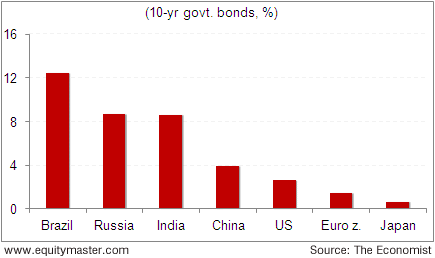
Interest rates in the emerging world stay high
While the interest rates in the West remain low, those in the BRIC nations have been quite firm. while the rich world has been grappling with deflation, for these emerging economies especially India, inflation remains a key concern. In India at least, high inflation has been a problem for quite some time now. And the RBI is in no mood to ease rates unless this comes down within acceptable levels. If the Modi government gets its development agenda rolling and many of the supply side bottlenecks are done away with, then there are very good chances of inflation cooling off. And this will be a good enough signal for the RBI to also start reducing interest rates.
Bank of America is in talks to pay at least $12B
To settle mortgage-related probes from the Department of Justice and various states. The DOJ was previously reported to be seeking more than $13B from BofA (BAC) over its mortgage lending - generally over loans tied to Countrywide and Merrill Lynch. The bank has already reached a $9.5B settlement with the Federal Housing Finance Agency.
Subscribe to:
Posts (Atom)

 Posts
Posts

